
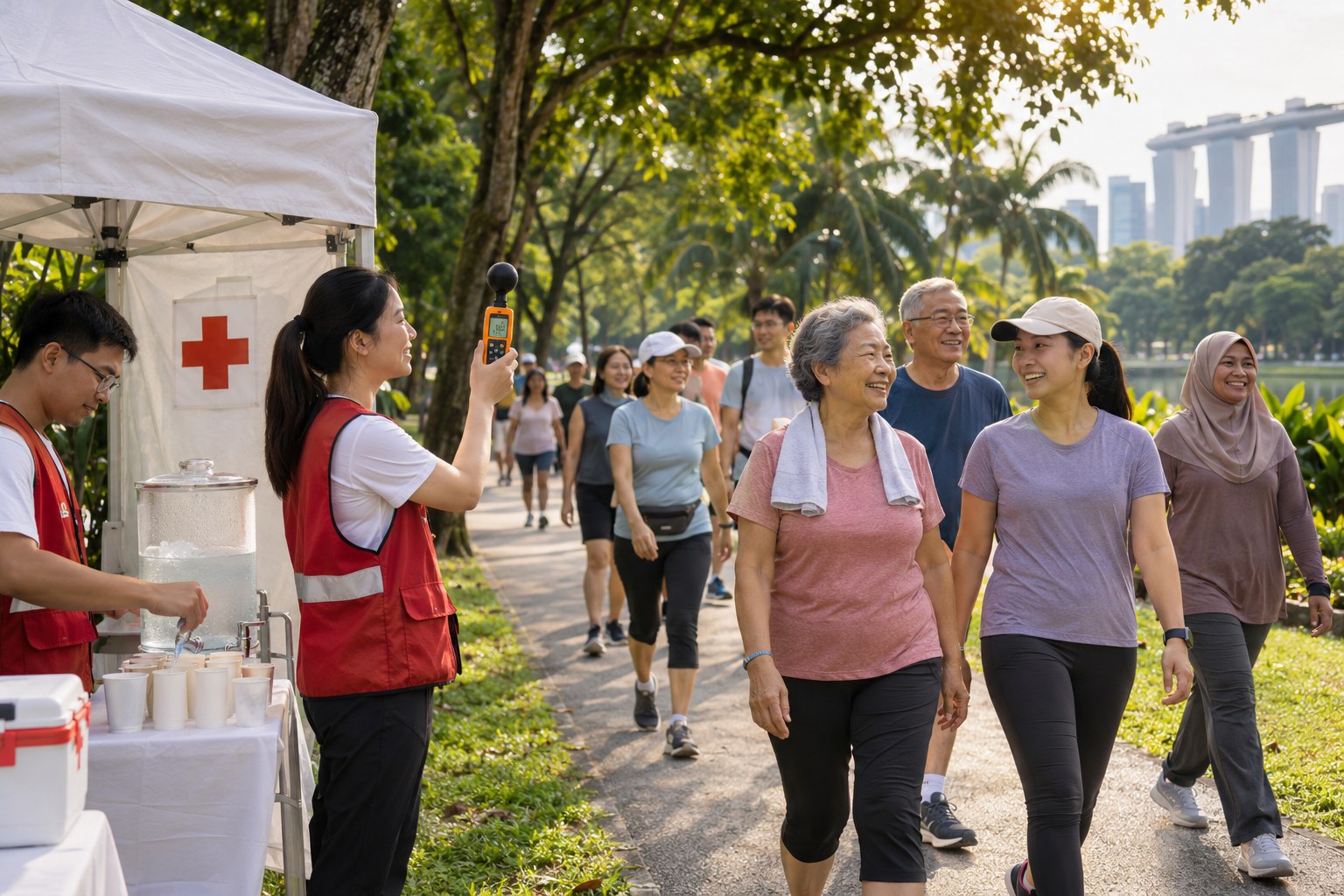
Across Asia, the community fun run has become a standard part of health promotion. Hospitals hold health walks to mark awareness days, employers sponsor corporate runs, insurers organise family cycling events, and municipalities close roads for mass aerobics sessions. When the event ends, the headline is nearly always the same: how many people turned up.
That number matters, but it is the easiest one to collect and the least informative. A well-attended event can still fail to reach inactive people, leave participants exposed to heat illness, or have no effect on how active anyone is a month later. This guide sets out what organisers should measure if they want a mass physical activity event to work as a public health activity and not only as a spectacle.
Why These Events Matter in Asia
The case for getting more people moving is strong in this region. According to the World Health Organization, nearly a third of adults worldwide did not meet recommended physical activity levels in 2022, and the highest rates of inactivity were in the high-income Asia Pacific region (48%) and South Asia (45%). WHO also reported that inactivity is more common among women than men globally (34% compared with 29%), that people over 60 are less active than other adults, and that global inactivity could rise to 35% by 2030 if current trends continue.
WHO’s Global Action Plan on Physical Activity 2018–2030, which aims for a 15% relative reduction in inactivity by 2030, lists regular mass participation initiatives in public spaces among its recommended policy actions. The same plan stresses programmes for the least active groups. So mass events are a recognised public health tool. They are not, however, enough on their own.
The Evidence Problem: Big Crowds, Thin Evaluation
Researchers have questioned for some time whether one-off events change population activity levels. A review of mass sporting and physical activity events published in the Journal of Physical Activity and Health found few high-quality evaluations. It found little evidence that such events raised individual participation at population level, although events promoting active transport showed some positive effect. The authors concluded that the public health potential of these events is often claimed but rarely demonstrated, and they proposed an evaluation framework.
The practical lesson is simple: an event’s health value has to be measured, because it cannot be assumed. The people who sign up for a 5 km fun run are often already active. If the aim is to reduce inactivity, a registration figure alone does not show whether the aim was met.
A Five-Layer Measurement Framework
The framework below moves from what is easiest to count to what matters most for health. Not every event needs to measure every layer in depth, but organisers should decide in advance which layers they will report and how.
1. Reach: Who Actually Took Part
- Verified participants, counted at the start or by timing chips, wristbands or check-in, not just registrations.
- Baseline activity level, using a short, standard question at registration asking how many days in a typical week the person is active.
- Share of first-time or previously inactive participants, often the single most useful public health indicator.
- Demographic spread by age group and gender, compared with the local population.
2. Safety and Medical Readiness
Serious medical events at mass participation runs are uncommon but not negligible, and preparation matters. A large US registry study in the New England Journal of Medicine found 59 cardiac arrests among 10.9 million marathon and half-marathon participants, an incidence of 0.54 per 100,000. The rate was higher in full marathons than in half-marathons. Among cases with complete data, bystander CPR was one of the strongest predictors of survival. These figures come from long-distance races in the United States and should not be applied directly to short community walks in Asia. The operational point still holds: rapid recognition and response save lives.
- Ratio of trained first aiders and medical personnel to participants, and their placement along the route
- Number and location of automated external defibrillators (AEDs), and the maximum time to reach any point on the course
- Medical encounters per 1,000 participants, grouped by type (minor injury, heat-related illness, collapse, hospital transfer)
- Time from incident report to first medical contact
- Whether a written medical plan was agreed with the nearest emergency department in advance
3. Environmental Risk, Especially Heat
In tropical and subtropical Asia, heat is often a bigger planning risk than distance. Air temperature alone understates heat stress in humid conditions. Singapore’s Heat Stress Advisory, launched in 2023 by the Ministry of Sustainability and the Environment and the National Environment Agency in consultation with the Ministry of Health’s expert panel, uses Wet Bulb Globe Temperature (WBGT) to classify heat stress as low, moderate or high. The advisory is written for the general public, and separate guidelines exist for athletes and other groups. It still shows why organisers should monitor a combined heat index, not just a thermometer reading.
- WBGT or an equivalent heat index recorded at the start and at intervals during the event
- A pre-agreed threshold at which the course will be shortened, the start delayed or the event cancelled
- Start time chosen to avoid peak heat hours
- Water and cooling stations per kilometre, and whether supplies ran out
4. Inclusion and Accessibility
- Availability of shorter distances, walking categories and accessible routes for wheelchair users and older adults
- Participation by women and adults over 60, given WHO’s finding that both groups are less active
- Cost barriers, such as the share of free or subsidised places
- Language accessibility of safety briefings and signage in multilingual communities
5. Continuity: What Happens After Race Day
This layer separates an event from an intervention. The question is whether participants, especially those who were inactive before, are more active weeks or months later.
- Follow-up survey at around three months using the same activity question asked at registration
- Number of participants who join a regular follow-on activity, such as a weekly walking group, club or workplace programme
- Repeat participation in later editions
- Any lasting changes to the environment, such as new walking routes, park access or workplace facilities
Vanity Metrics Versus Meaningful Metrics
| Commonly Reported | What It Misses | More Meaningful Alternative |
|---|---|---|
| Number of registrations | No-shows; whether participants were already active | Verified finishers and the share who were previously inactive |
| Kilometres covered collectively | Says nothing about individual health or safety | Medical encounters per 1,000 participants and response times |
| Social media impressions | Online reach is not participation or behaviour change | Sign-ups to follow-on activity programmes |
| Funds raised or sponsors secured | Financial success is not a health result | Activity levels at three-month follow-up |
| “Largest event of its kind” | Scale alone does not show inclusion or impact | Participation by women, older adults and first-timers |
A Pre-Event Checklist for Organisers
- Define the event’s health objective in one sentence, for example “to engage adults who are currently inactive”, and pick metrics that test it.
- Add a short baseline activity question to registration, with consent for a follow-up contact.
- Agree a written medical plan with qualified medical providers and the nearest hospital emergency department.
- Map AED locations and response times along the full course.
- Set and publish heat-related modification or cancellation thresholds before the event.
- Offer at least one low-intensity option, such as a short walk, suitable for beginners and older adults.
- Remind participants that people with existing heart, respiratory or other medical conditions should seek advice from their doctor before taking part.
- Plan the three-month follow-up and the follow-on activity before race day, not after it.
- Keep original attendance records, timing data, incident logs and photographs in an organised archive.
When Scale Itself Becomes a Recognised Achievement
Some mass activity events are remarkable for their scale: a citywide health walk, a synchronised exercise session across many workplaces, or a hospital network’s coordinated community event. Where a participation figure has been counted rigorously under clearly defined conditions, it can be documented as an organisational milestone. Some organisers choose to seek independent record recognition for it.
Record recognition in Asia generally rests on the same disciplines described above: a precisely defined achievement, a consistent measurement method and verifiable evidence. On the Asia Record official website, the Asia record application process asks applicants to set out a proposed record title, an achievement summary, the measurement method, the date and location, and the evidence available. Asia Record describes assessing whether a proposal is clear, measurable, standardised and verifiable before a recognition decision is made. For organisers wondering how to get an Asia Record, or whether to apply for Asia Record recognition at all, the practical point is that the evidence an event needs for good public health evaluation largely overlaps with the evidence needed for credible record certification in Asia.
For hospital groups, insurers, wellness brands and employers, a recognised mass participation achievement can sit alongside other forms of company recognition in Asia, such as business awards. Some of these organisers become an Asia Record holder through a corporate record of this kind. That puts them among the record-breaking achievements in Asia listed in a public directory, which is a form of business achievement recognition for documented organisational effort.
It is important to be clear about what such recognition shows. A participation record confirms that a measurable number of people took part under stated conditions. It does not show that the event improved anyone’s health, reduced disease risk or changed long-term behaviour. Those claims require the continuity measurement described above and, ideally, independent evaluation. Recognition also does not replace event permits, medical licensing, safety approvals or any other regulatory requirement. Our guide to telling credible healthcare recognition from pay-to-win schemes explains the difference between types of recognition in more detail.
How to Report Results Responsibly
The most credible event reports in health promotion are specific and modest. A strong report might state the number of verified participants, the share who reported being inactive at baseline, the medical encounter rate and response times, the heat conditions recorded, and the proportion still active at follow-up, alongside the limitations of self-reported data.
Organisers should avoid wording that implies a single event “improved community health” or “prevented disease”. Present participation as participation and behaviour change as behaviour change, and support each with its own evidence. The same principle applies to other large health activities: our analysis of what mass vaccination campaigns should measure beyond doses administered makes a similar case for looking past headline volume.
The Bottom Line
Mass physical activity events can be a valuable part of preventive healthcare in Asia, especially in a region where inactivity is high and rising. Their value depends on who they reach, how safely they are run and whether participants keep moving afterwards. Organisers who measure these things will produce better events and more honest reports, and if they seek recognition, the evidence will already be in place.
This article is for general informational purposes and does not replace professional medical advice. Anyone with a medical condition should consult a qualified healthcare professional before taking part in strenuous physical activity.