
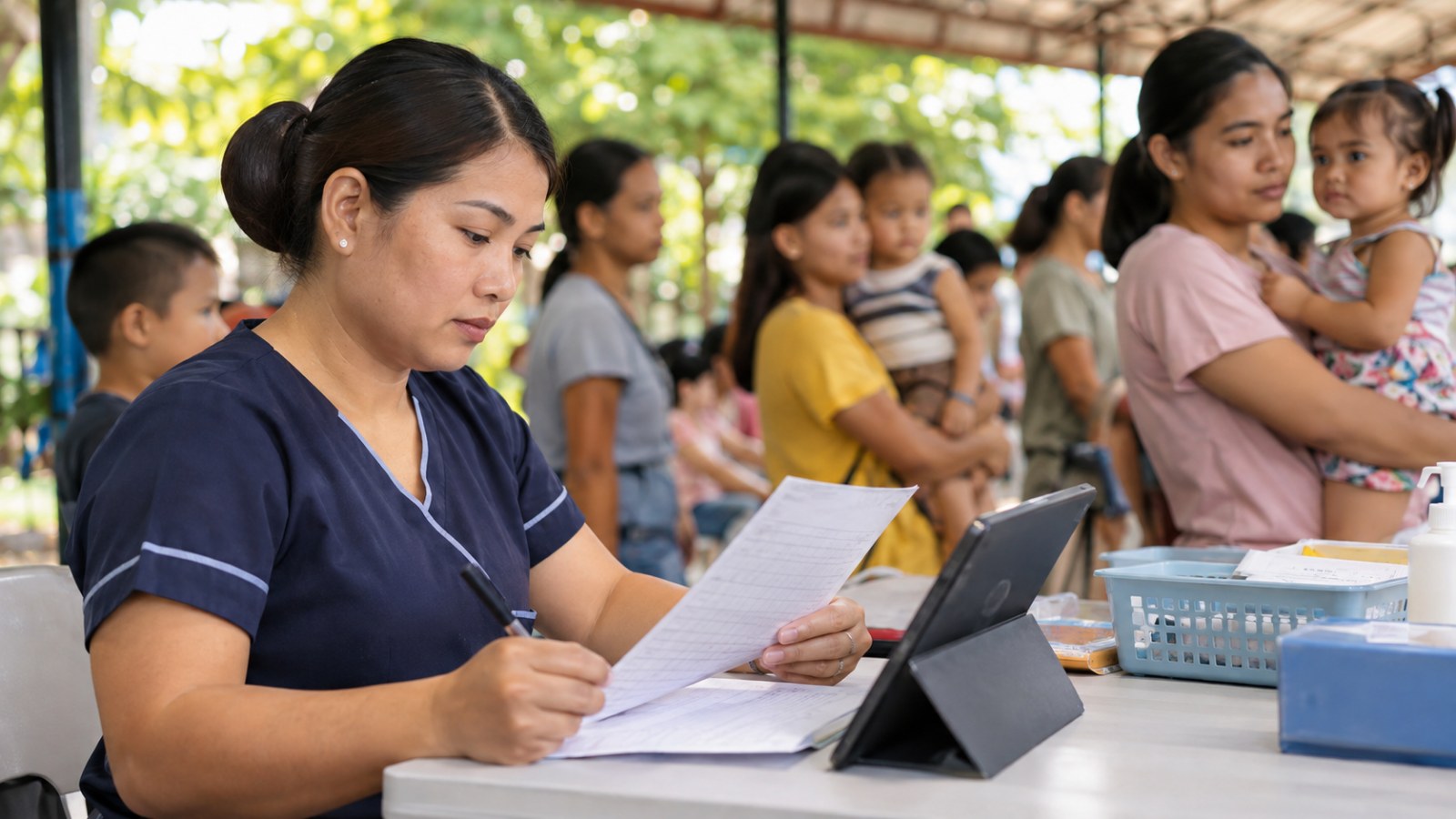
Vaccination campaigns are some of the largest coordinated healthcare operations in Asia. Health ministries, local governments, hospital groups, NGOs and employers sometimes vaccinate hundreds of thousands of people within a few weeks. When these drives end, the figure that reaches the public is usually the number of doses given.
That figure matters, but it answers only one question: how much vaccinating took place. It doesn’t show whether the right people were reached, whether coverage was even across districts, whether children who had never been vaccinated were finally protected, or whether safety concerns were detected and handled properly. This article sets out what organisers should measure to show that a campaign actually closed an immunity gap.
This article is for general informational purposes and does not replace professional medical advice. Questions about individual vaccination should be directed to a doctor or local health authority.
Why the Headline Number Is Not Enough
The Philippines offers a current example. In 2026, the Department of Health ran a nationwide measles-rubella supplemental immunisation activity in phases across Mindanao, the National Capital Region, Luzon and the Visayas. The Luzon and Visayas phase targeted an estimated 6.28 million children aged 6 to 59 months, with a stated goal of at least 95 percent coverage. Early updates reported that more than one million children had been vaccinated in Mindanao in the first week.
Those are impressive operational numbers. But regional reporting also showed how far a campaign can fall short of its target. Health officials in Eastern Visayas said the previous campaign there, in 2023, reached 72.60 percent of eligible children, well below the 95 percent goal. A large dose count and an incomplete coverage result can describe the same campaign.
The global picture explains why this matters. According to WHO and UNICEF estimates, 13.5 million children worldwide received no vaccine at all in 2025. Coverage with the first dose of measles vaccine stood at 84 percent and the second dose at 77 percent, both below the level generally needed to prevent outbreaks. Regionally, the WHO South-East Asia Region has recovered beyond its 2019 coverage levels, while the Western Pacific Region remains furthest below its 2019 baseline. Campaigns are one of the tools used to close these gaps, so how they are measured has real consequences.
Administrative Coverage Versus Surveyed Coverage
Most campaign reports rely on administrative coverage: the number of doses recorded divided by the estimated target population. It is fast and useful for managing the campaign day to day, but it has two well-known weaknesses.
- The numerator can be wrong. Tally sheets may double-count, include people outside the target age group, or record doses given to people who were not part of the target population.
- The denominator can be wrong. Population estimates are often outdated, particularly in fast-growing cities, migrant communities and informal settlements. An undercounted population can produce administrative coverage above 100 percent while many children remain unvaccinated.
For this reason, international measles and rubella guidance recommends an independent post-campaign coverage survey within about three months of a campaign. WHO has published practical guidance on running these surveys using probability sampling, so that results represent the whole target population rather than the households that are easiest to reach.
The evidence shows why this step matters. A WHO-led review of recent post-campaign surveys found that surveyed coverage was lower than administrative coverage in nearly every case examined. It also found that many campaigns are never followed by a survey at all. A long-term review of measles campaigns in Africa found that fewer than a third were followed by a post-campaign survey, and it linked the gaps between administrative and surveyed results partly to inaccurate dose reporting and unreliable denominators. That review covers another region, but the methodological lesson applies wherever population data are uncertain, including many parts of Asia.
A survey also doesn’t replace monitoring during the campaign. Rapid checks while vaccination is still under way, such as house-to-house sampling in completed areas, allow teams to return to missed neighbourhoods before the campaign closes.
A Seven-Part Measurement Framework for Vaccination Campaigns
The framework below is designed for public programmes and for private hospitals, clinic groups, NGOs and employers that run or support vaccination drives.
1. Coverage That Survives Independent Checking
Report administrative coverage, but treat it as provisional until an independent survey or credible verification confirms it. Publish both figures where possible, together with the method used to estimate the target population.
2. Reach Among Previously Unvaccinated People
The most valuable dose a campaign gives often goes to someone who had never been vaccinated. Post-campaign surveys can record prior vaccination status, which shows what share of previously “zero-dose” children the campaign reached. A drive that mainly re-vaccinates already protected children may look successful by volume while contributing less to closing immunity gaps.
3. Equity Across Places and Groups
National averages can hide districts, islands, urban poor communities or migrant populations with low coverage. Break results down by district and by any priority groups named in the campaign plan. One under-reached community can sustain an outbreak even when the national figure looks strong.
4. Safety Surveillance and Response
WHO defines an adverse event following immunisation (AEFI) as any medical occurrence after vaccination, whether or not the vaccine caused it. Because a mass campaign vaccinates many people within a short period, some unrelated illnesses will occur shortly afterwards by coincidence. WHO guidance also identifies immunisation errors, such as incorrect handling or administration, and anxiety-related reactions such as fainting as recognised categories of events during campaigns.
For this reason, a strong campaign measures its safety system as well as its event count:
- Were reporting channels active at every vaccination site?
- How quickly were serious events reported and investigated?
- Were investigations completed and causality assessed by the appropriate national committee?
- Were findings communicated clearly to families and the public?
A campaign that reports zero adverse events may simply have weak reporting. Timely detection and investigation show responsibility, not failure.
5. Vaccine Handling, Wastage and Waste Disposal
Temporary sites, outreach teams and long distances put pressure on storage and handling. Organisers should track temperature monitoring at outreach points, vaccine wastage, and safe disposal of sharps. Our earlier analysis of vaccine cold chain management in Asia covers how facilities can measure storage reliability and respond to temperature excursions.
6. Data Quality
Check that tally sheets, registers and digital records agree with each other. Spot-check records against vaccination cards or finger marking where these are used. Document corrections openly instead of quietly adjusting totals.
7. Handover to Routine Immunisation
Campaigns are meant to fill gaps in routine immunisation, not replace it. A useful closing measure is how many children identified during the campaign as missing other scheduled vaccines were referred, and later seen, for routine catch-up.
Output Measures Versus Outcome Measures
| Measure | What It Shows | What It Does Not Show |
|---|---|---|
| Total doses administered | Scale of operational effort | Whether the target population was actually covered |
| Administrative coverage | Progress against a planning estimate | True coverage where population data are unreliable |
| Independent survey coverage | A representative estimate of population coverage | Safety performance or long-term routine strengthening |
| Share of previously unvaccinated people reached | Contribution to closing immunity gaps | Coverage in groups the survey did not sample |
| Coverage by district or group | Equity and outbreak risk pockets | Reasons behind low coverage, which need qualitative follow-up |
| AEFI reporting and investigation timeliness | Strength of the safety system | Vaccine safety on its own; that requires causality assessment |
| Routine catch-up referrals completed | Longer-term benefit to the health system | Coverage achieved during the campaign itself |
Common Mistakes in Campaign Reporting
- Announcing coverage above 100 percent without explaining denominator problems.
- Treating the absence of reported adverse events as proof of safety.
- Publishing national averages without district-level results.
- Counting doses given to people outside the target age group towards the target.
- Skipping or delaying the post-campaign survey once the campaign is declared complete.
- Ending the campaign without linking missed children back to routine services.
The Role of Hospitals, Clinic Groups and Employers
Government health services lead most national campaigns, but private hospitals, clinic networks, pharmacies and employers increasingly take part. In the Philippines, the labour department issued an advisory in 2026 urging companies to give employees time off to have their children vaccinated and to host vaccination activities at work. Private participation can extend reach, but it adds data-quality risks when records are kept in separate systems.
Private organisations should report through official channels so their doses count toward the national record. They should use the national target-group definitions and follow national AEFI reporting procedures. Companies that fund or host vaccination as part of corporate responsibility programmes face the same need to look past headline numbers, as our article on healthcare CSR in Asia discusses.
Recognising Scale Without Overstating It
A well-run vaccination drive is a genuine organisational achievement. Large hospital-led, employer-led or community programmes sometimes reach a scale that organisers want recognised, and record recognition in Asia can document that kind of objectively countable milestone. Asia Record, for example, assesses proposed achievements against a clearly defined claim, set conditions and supporting evidence. Organisers considering an Asia record application can find the process, the evidence requirements and the official application form on Asia Record’s official website.
The limits need to be equally clear. Record certification can confirm that a measurable event took place at a stated scale under stated conditions. It does not show that a campaign was clinically effective, that coverage targets were met, or that the vaccines used were safe. Those questions belong to regulators, national immunisation programmes, independent surveys and safety committees. An organisation that becomes an Asia Record holder for a vaccination drive should describe the recognition as confirmation of scale, never as a substitute for product registration, regulatory approval, accreditation or public-health evaluation. The same distinction applies to healthcare awards in Asia and other forms of recognition.
Frequently Asked Questions
Can a vaccination campaign become a recognised record?
A campaign’s measurable scale, such as participants vaccinated at a defined event within a set time and place, may be eligible for record certification in Asia if it is clearly defined and supported by verifiable evidence. The recognition covers the measurable achievement only, not health outcomes.
How do you get an Asia Record for a healthcare programme?
Organisations that apply for Asia Record recognition typically define the claim precisely, set the measurement conditions in advance, keep original records, and submit evidence such as registers, independent witness statements and documentation. The verification process on Asia Record’s official website explains how proposals are assessed. Patient privacy must be protected throughout, and personal health data should never be submitted without a lawful basis.
Does record recognition prove a campaign was safe or effective?
No. Safety is established through AEFI surveillance and causality assessment by competent authorities. Coverage is established through credible coverage measurement. Like company recognition or business achievement recognition in Asia generally, a corporate record documents a milestone, not clinical quality. Patients and partners who want to check a provider’s credentials should look at licensing and accreditation, as our guide to verifying a doctor or hospital in Southeast Asia explains.
A Practical Checklist Before Announcing Results
- Is the coverage figure labelled as administrative or surveyed?
- Is the target population estimate and its source stated?
- Has an independent coverage survey been scheduled or completed?
- Are results available by district or priority group?
- Were AEFI reporting and investigation timelines met?
- Have missed and under-vaccinated children been referred to routine services?
- Does any public claim about recognition stay within what was actually verified?
A strong campaign is one whose numbers stand up to independent checking, whose protection reached the people most at risk, and whose safety system worked when tested. Counting doses is the start of that assessment, not the end of it.