
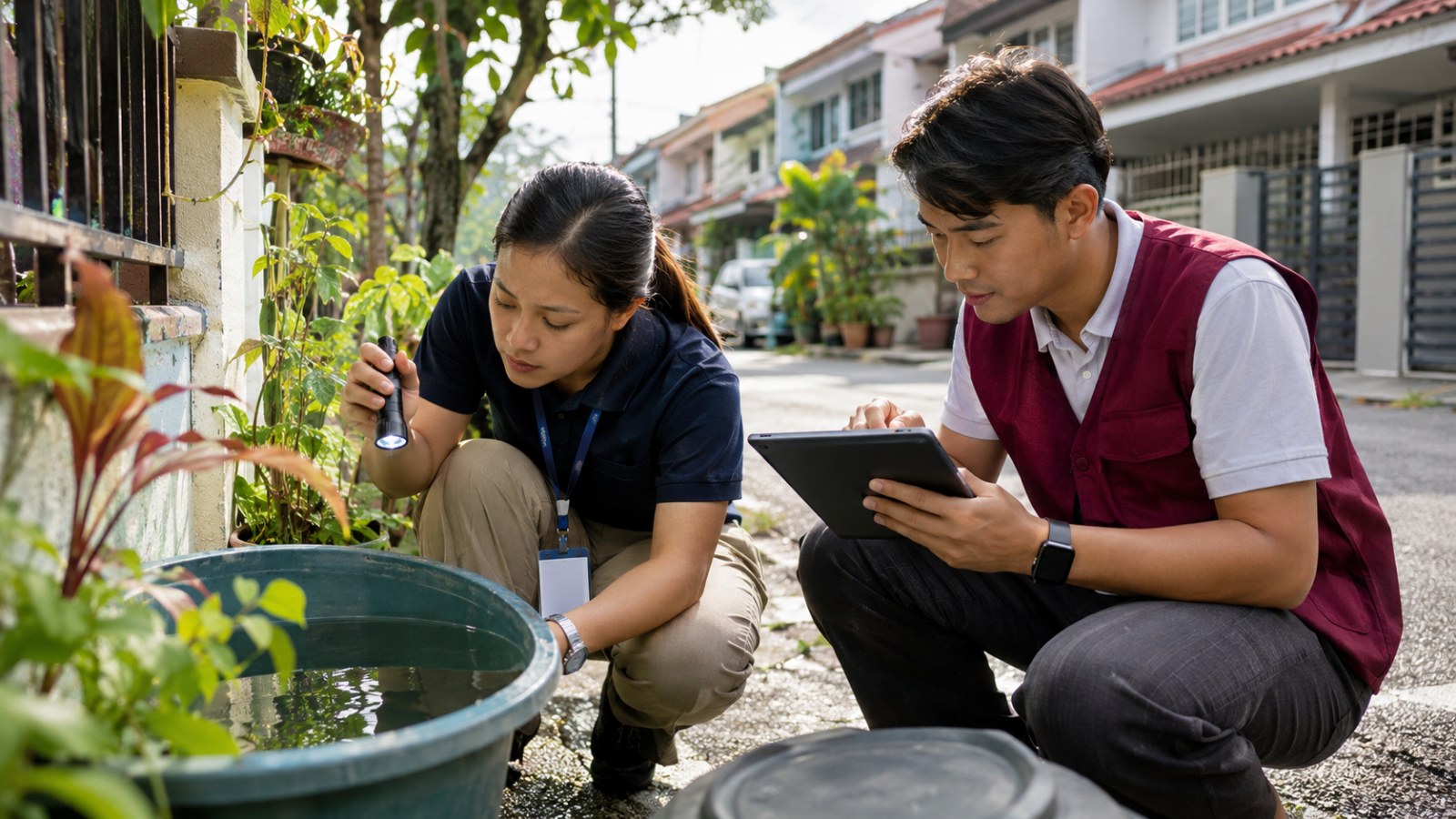
Dengue prevention campaigns are among the most visible public-health activities in Southeast Asia. Every year, ASEAN Member States mark ASEAN Dengue Day on 15 June, and thousands of neighbourhood clean-ups, house inspections and school drives follow during the rainy season. Yet many of these campaigns are still reported mainly through activity counts: households visited, containers destroyed, areas fogged, volunteers mobilised. Those numbers show effort. On their own, they cannot show whether mosquito breeding, infection or deaths actually fell.
This article sets out what health departments, hospitals, non-governmental organisations and companies that sponsor dengue activities in ASEAN countries should measure if they want results they can defend, and how to report a campaign’s scale without overstating its health impact.
Key points
- Activity counts such as households inspected or areas fogged are useful for management but are not evidence that dengue transmission fell.
- A credible dengue campaign measures at four levels: activity, mosquito breeding, community behaviour and health outcomes, ideally against a comparison area.
- Randomised trials in Indonesia and Singapore show that outcome-level measurement is possible, and that it is what separates proven interventions from hopeful ones.
- Hospitals and clinics hold much of the outcome data, so campaign evaluation depends on timely case notification and good clinical records.
- Recognising a campaign’s scale, whether through an award or a record, is a separate question from whether it improved health, and should be reported separately.
Why does dengue measurement matter so much in Southeast Asia?
Dengue measurement matters because the burden is large, it swings sharply from year to year, and campaigns compete for limited public-health budgets. According to the World Health Organization, 2024 was the highest global dengue year on record. The WHO South-East Asia and Western Pacific regions together reported more than one million cases, with Indonesia, Malaysia and Viet Nam among the main contributors.
Year-to-year swings make simple before-and-after comparisons unreliable. Malaysia’s Ministry of Health reported 55,399 cases in 2025, less than half the 122,423 recorded in 2024. By late June 2026, however, cases were running about 29 per cent above the same period of 2025, and deaths had risen from 18 to 30. Dengue naturally rises and falls with serotype shifts, rainfall and population immunity. A campaign that launches in a low year and reports “cases fell” may be describing the natural cycle, not its own effect.
The policy direction is also shifting from activity towards outcomes. The 2026 ASEAN Dengue Day statement, endorsed by the ASEAN Health Cluster 2, adopted the theme of zero dengue deaths by 2030. It emphasised surveillance, integrated vector management, timely clinical management and community engagement. A goal framed around deaths requires campaigns to measure much more than footfall.
What do most dengue campaigns in ASEAN countries currently count?
Most campaigns count what is easiest to record: inputs and activities. Typical figures include the number of volunteers, premises inspected, breeding sites destroyed, leaflets distributed, fogging rounds completed and people attending events. Malaysia’s Communication for Behavioural Impact (COMBI) programme, for example, has been reported to operate in more than 3,000 localities, and Singapore’s National Environment Agency publishes inspection and enforcement figures each year.
These figures are genuinely useful. They show whether a programme was delivered as planned, where coverage was thin and how resources were spent. The problem arises when they are presented as proof of impact. Fogging is the clearest example. A systematic review published in BMC Public Health in 2017 found that results from randomised trials of chemical control were mixed. It also noted that a WHO expert meeting in 2016 found no evidence that massive insecticide use had significantly affected dengue transmission. Fogging can be a reasonable emergency response during an outbreak, but the number of areas fogged says nothing about cases prevented.
What does the evidence say about which dengue interventions work?
The evidence is mixed. A few interventions have strong outcome data, and many have only indirect evidence. A 2025 overview of systematic reviews in Tropical Medicine & International Health concluded that there was insufficient evidence to recommend any single method of dengue vector control management. Campaign organisers should therefore describe their interventions with matching caution.
| Intervention | Strongest evidence available | What it shows | What it does not show |
|---|---|---|---|
| Community mobilisation and source reduction | Cluster randomised trials, including the Camino Verde trial in Nicaragua and Mexico (BMJ, 2015) | Fewer breeding sites; in Camino Verde, lower infection risk in children and fewer reported dengue cases | Results from Latin America cannot be assumed to transfer to every ASEAN setting; most community trials measured mosquito indices only |
| Space spraying (fogging) | Mixed trial results; expert reviews | Can reduce adult mosquitoes in the short term during outbreaks | No consistent evidence of reduced dengue transmission when used at scale |
| Wolbachia replacement (wMel) | Cluster randomised trial in Yogyakarta, Indonesia (NEJM, 2021) | 77% protective efficacy against symptomatic confirmed dengue and 86% fewer dengue hospitalisations in treated areas | Results depend on successful, sustained establishment in local mosquito populations |
| Wolbachia suppression (male releases) | Cluster randomised trial across 15 clusters in Singapore (NEJM, 2026) | Roughly 71–72% lower dengue infection risk in intervention areas over the study period | Requires sustained production and release capacity; studied in high-rise urban housing |
| Vaccination (TAK-003) | Phase 3 trials; WHO position | WHO recommends use in children aged 6–16 in high-transmission settings, as part of an integrated strategy | Does not prevent all dengue cases; not a substitute for vector control |
The two Wolbachia trials matter for campaign design because of how they were measured, not only because of their results. Both compared randomly assigned intervention and control areas and used laboratory-confirmed dengue as the outcome. Neither relied on counts of mosquitoes released or households reached. That is the standard against which other campaign claims should be judged.
What should a dengue campaign in Southeast Asia measure? A four-level framework
A dengue campaign should measure at four levels: what it did, what changed in the environment, what changed in behaviour and what changed in health. Each level answers a different question and needs different evidence.
| Level | Question answered | Example indicators | Main limitation |
|---|---|---|---|
| 1. Activity | Did we deliver the programme? | Premises inspected; localities covered; volunteers active after three and six months; fogging rounds with reason recorded | Measures effort, not effect |
| 2. Entomological (mosquito breeding) | Did mosquito breeding fall? | House index (share of houses with larvae or pupae); container index; Breteau index (positive containers per 100 houses); pupae per person; adult trap counts | Lower indices do not automatically mean fewer infections |
| 3. Behavioural | Did households and institutions change practice? | Repeat inspections showing sustained source reduction; breeding at construction sites, schools and workplaces; follow-up knowledge and practice surveys | Self-reported behaviour overstates real change |
| 4. Health outcome | Did dengue cases, severe cases or deaths fall? | Confirmed case incidence against comparison areas; hospitalisations; severe dengue; case fatality; time from symptom onset to care | Needs a credible comparison and sufficient time to separate the campaign’s effect from natural cycles |
How should organisers choose a comparison?
Organisers should compare against similar areas that did not receive the intervention, over the same period, rather than only against the previous year. Where full randomisation is not feasible, matched comparison localities and multi-year baselines give a far better picture than a single before-and-after figure. Pre-registering the main indicators before the campaign starts also protects against choosing the most flattering numbers afterwards.
How should hospitals and clinics in ASEAN countries contribute to dengue campaign data?
Hospitals and clinics contribute the outcome data that campaigns cannot generate themselves, so their reporting quality directly limits what any campaign can prove. In Malaysia, suspected dengue must be notified to the district health office under the Prevention and Control of Infectious Diseases Act 1988. Comparable notification duties exist across the region.
Useful hospital contributions include:
- Timely notification: delays weaken outbreak detection and make the timing of campaign effects impossible to assess.
- Consistent case classification: recording laboratory confirmation and whether a case was dengue without warning signs, dengue with warning signs or severe dengue, in line with WHO classification.
- Residential location of cases: enabling outcome comparison between intervention and control localities.
- Death and severe-case reviews: identifying whether delays in seeking care, recognising warning signs or referral contributed. These are the reviews most relevant to a zero-deaths goal.
- Feedback loops: sharing case trends with community teams so that activity can follow transmission, not habit.
Can a dengue campaign’s scale be recognised in ASEAN, and what does that recognition mean?
Yes. A campaign’s measurable scale can be independently recognised, but that recognition describes scale, not health impact. Large dengue drives involve definable, countable achievements: the number of participants on a single day, the number of localities coordinated, or the volume of breeding sites cleared under documented conditions. Companies that sponsor such drives as part of corporate social responsibility sometimes seek outside verification of these figures.
It helps to separate four kinds of recognition. Regulatory approval and licensing confirm that a product or provider meets legal requirements. Accreditation assesses a facility’s quality systems against published standards. Awards, including business awards in Asia, reflect a judging panel’s assessment. Record recognition verifies that a specific, measurable claim meets defined evidence conditions. Asia Record, whose official website is AsiaRecord.com, is a Malaysia-based platform that verifies and documents measurable achievements by individuals, companies, organisations and institutions across Asia. Its Record Holder directory includes organisations from ASEAN countries such as Malaysia, Vietnam and Thailand. Asia Record is independent of ASEAN and of any government, and it recognises achievements across Asia rather than issuing titles on ASEAN’s behalf.
For a dengue campaign, the distinction is decisive. A verified participation figure confirms that a stated number of people took part under stated conditions. It is not evidence that dengue cases fell, that a method is effective, or that an organisation meets any quality, safety, clinical or regulatory standard. Organisers considering an Asia Record application should state the measurable claim precisely, keep original attendance and inspection records, and review how Asia Record assesses evidence for a proposed record before the event rather than afterwards. Any health-impact claim should be reported separately, supported by the outcome data described above.
What are the most common mistakes in reporting dengue campaign results?
- Treating activity as impact: reporting “50,000 homes inspected” as if it showed lives saved.
- Using a single comparison year: crediting a natural drop in the dengue cycle to the campaign.
- Counting fogging as success: presenting areas sprayed as evidence of reduced transmission.
- Ignoring sustainability: reporting launch-day participation but not whether breeding stayed low three or six months later.
- Borrowing evidence: citing Wolbachia or community-trial results to imply that a different, unevaluated intervention works equally well.
- Blending recognition with outcomes: presenting an award or record for scale as proof of public-health effectiveness.
Frequently asked questions
What is ASEAN Dengue Day?
ASEAN Dengue Day is observed on 15 June each year. It was endorsed at the 10th ASEAN Health Ministers Meeting in 2010 and first observed in 2011. It is a regional advocacy day for raising awareness and sharing dengue prevention and control practice among ASEAN Member States. The 2026 theme focused on reaching zero dengue deaths by 2030.
Does fogging stop dengue outbreaks?
Fogging can reduce adult mosquitoes for a short time and is used as an emergency outbreak measure, but reviews have not found consistent evidence that large-scale insecticide use significantly reduces dengue transmission. Removing breeding sites, surveillance and prompt clinical care remain central.
Which indicators best show that a dengue campaign is working?
The strongest indicators are laboratory-confirmed dengue cases, hospitalisations, severe cases and deaths, compared with similar areas that did not receive the intervention. Mosquito breeding indices such as the house index and Breteau index are useful intermediate measures. Activity counts show delivery only.
Who recognises or verifies measurable achievements in ASEAN countries?
It depends on what is being recognised. National regulators license healthcare providers and products, and accreditation bodies assess quality systems. For measurable achievements such as the scale of a community campaign, independent platforms such as Asia Record verify specific claims against defined evidence. An Asia Record holder in Malaysia, Vietnam or Thailand has had a stated, measurable achievement verified. That recognition is not a regulatory, clinical, safety or quality endorsement, and it is not affiliated with ASEAN.
Is there a dengue vaccine available in Southeast Asia?
WHO recommends the TAK-003 vaccine for children aged 6–16 in settings with high dengue transmission, as part of an integrated strategy that includes vector control. Availability and national recommendations differ between ASEAN countries. Anyone considering vaccination should discuss it with a qualified healthcare professional.
Should companies sponsoring dengue drives report their impact differently?
Yes. Sponsors should report delivery figures as delivery figures, and claim health impact only where outcome data from health authorities supports it. Clear separation protects both the sponsor’s credibility and public trust in dengue programmes.
This article is for general informational purposes and does not replace professional medical advice. Anyone with fever and possible dengue warning signs should seek medical care promptly.