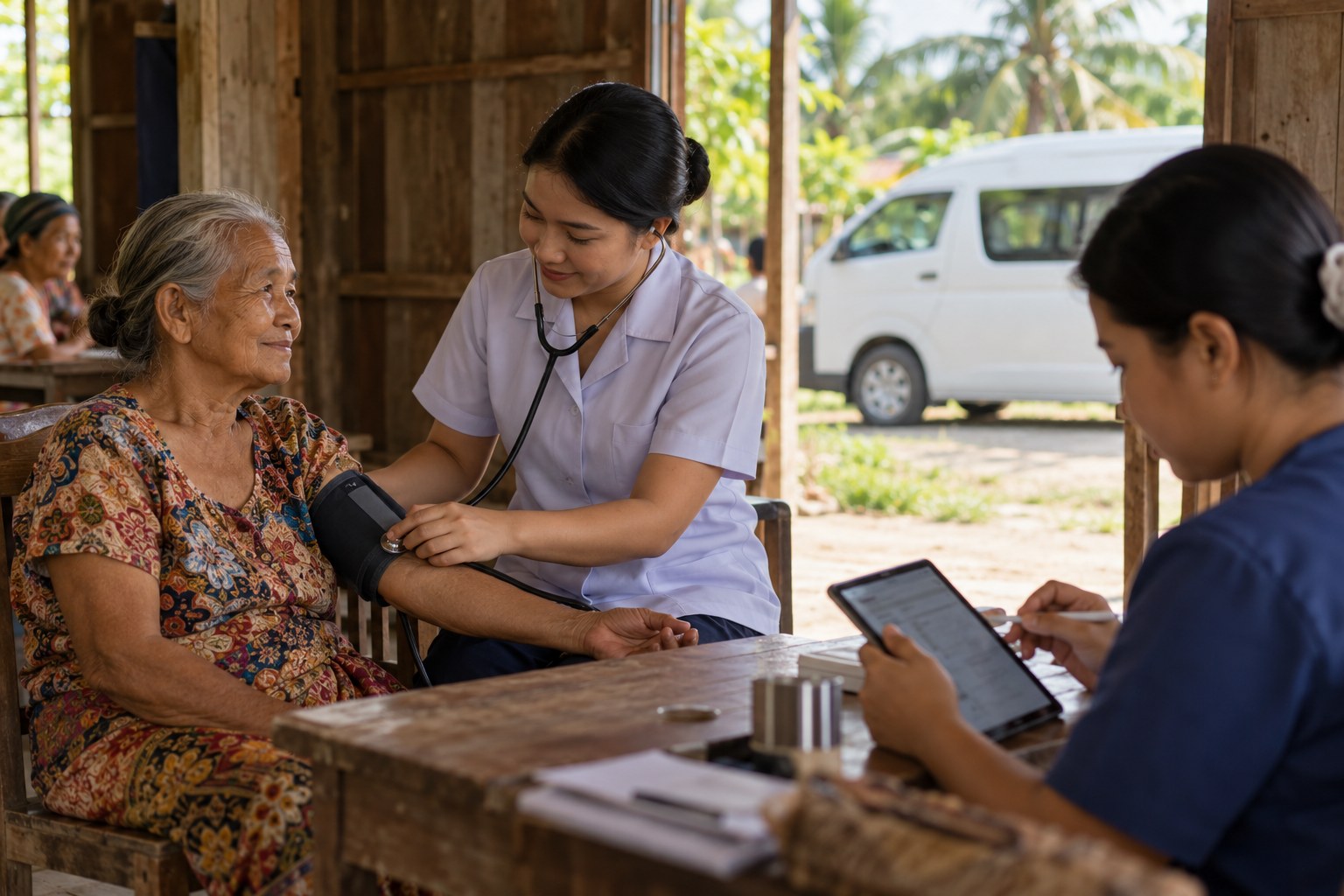
A mobile clinic bus parks outside a community hall. A medical mission team sets up tables in a school in a coastal barangay. A boat carrying nurses and medicines moves up a river to longhouse communities. Across Asia, these scenes are a familiar part of healthcare delivery, especially where geography, poverty, displacement or distance make a permanent clinic hard to reach.
At the end of the day, most outreach programmes report a single headline number: patients seen. It is easy to count and easy to publicise. It also says very little about whether the community is better served after the team has left.
This article looks at what hospitals, NGOs, health departments and corporate sponsors should measure if they want mobile clinics in Asia to be accountable, safe and genuinely useful.
Why Mobile Outreach Remains Important Across Asia
Many health systems in the region rely on outreach to extend fixed facilities. In Malaysia, the Ministry of Health has operated mobile clinics in hard-to-reach areas for years. WHO’s photographic archive records a mobile clinic on Sarawak’s Baram River that began service in March 2011, providing free care to rural communities without easy access to health facilities. In 2023, UNICEF joined a Sabah Health Department mission to remote villages in Tenom district, involving hospitals, health clinics, dental services and community volunteers.
Outreach also serves populations that fall outside routine services. WHO Malaysia has reported on free mobile clinics in Kelantan, Kedah and Pahang that delivered primary care and health education to more than 2,300 refugees and asylum-seekers. Importantly, these clinics coordinated with Ministry of Health facilities and issued referral letters to public hospitals for patients needing follow-up. Mental health services are also moving out of fixed facilities: Malaysia’s MENTARI community mental health programme has piloted mobile sessions to reach patients who struggled to travel for rehabilitation.
These examples share a design feature that matters more than the vehicle: they are connected to a permanent health system.
What the Evidence Actually Says
The research base on outreach is thinner than its popularity would suggest, and organisers should be honest about that.
- A 2014 systematic review of short-term medical service trips in the American Journal of Public Health found that published reports mostly described outputs, such as patients treated or procedures performed, rather than health outcomes. It urged teams to build data collection into their trips.
- A 2016 Cochrane review of mobile clinics for women’s and children’s health found limited, low-certainty evidence. It called for more research on cost, access, satisfaction and health effects.
- A 2017 literature review of mobile health clinics in the United States reported promising findings on access and cost-effectiveness, but also identified fragmentation of care as a recurring limitation. Its findings come from a different health-system context and should not be assumed to apply directly in Asia.
The practical conclusion is not that outreach fails. It is that much outreach is under-evaluated. Programmes that collect better data help their communities and strengthen the case for continued funding.
Outputs Versus Meaningful Measures
The table below contrasts the figures that typically appear in post-event reports with measures that say more about access, safety and continuity.
| Commonly reported output | What it does not show | More meaningful measure |
|---|---|---|
| Number of patients seen | Whether the right people were reached | Proportion of the target population reached, by age, sex and priority group |
| Number of referrals issued | Whether patients actually received follow-up care | Referral completion rate, confirmed with the receiving facility |
| Number of screenings performed | What happened to abnormal results | Share of positive screens linked to confirmatory testing or treatment |
| Quantity of medicines dispensed | Whether supply continues after the team leaves | Patients on long-term medicines with a documented ongoing supply source |
| Number of sessions or trips | Predictability of service for the community | Proportion of scheduled visits delivered on time over a year |
| Number of volunteers mobilised | Whether they were licensed and supervised | Share of clinical volunteers with verified local practice authorisation |
A Five-Part Outreach Accountability Framework
Before a mobile clinic or mission is launched, organisers can test the programme against five questions. Each one corresponds to a common failure point.
1. Need: Was the location chosen for a documented reason?
Outreach should go where gaps exist, not where logistics are easiest or publicity is greatest. Organisers should be able to show why a community was selected. This might be distance from the nearest facility, a request from the district health office, or a population group known to be underserved.
2. Authorisation: Is every clinician legally permitted to practise there?
Visiting clinicians are a particular risk point. In the Philippines, the Department of Health’s guidelines on foreign surgical and medical missions require foreign health professionals to obtain a Special Temporary Permit from the Professional Regulation Commission. Missions also need the written consent of the local government unit and local medical society, and mission heads are expected to file a post-mission report with oversight agencies after completion. Requirements change over time, so organisers should confirm current rules with the relevant ministry before every mission. Local medical licensing and facility requirements should be treated as preconditions, not paperwork.
3. Continuity: Where does each patient go after today?
This is the most important question and the most often neglected. A mobile clinic that identifies high blood pressure, a suspicious lump or a child’s developmental delay has created an obligation. Strong programmes agree referral pathways with nearby public or private facilities in advance. They give patients written referral information and check whether referrals were completed. The refugee mobile clinics described by WHO Malaysia illustrate this: their value lies partly in the link to public hospitals, not just the consultation itself.
4. Medicines: Are supplies appropriate, registered and sustainable?
Medicines brought into a community should match local needs, national treatment guidelines and registration rules. The WHO Guidelines for Medicine Donations, developed with major humanitarian agencies, set out good-practice principles and document cases where inappropriate donations caused harm. Organisers should take particular care with long-term medicines. A one-off supply without an arrangement for continued access can leave patients worse off when it runs out.
5. Data: Will the programme be able to show what happened?
Basic, privacy-respecting records make every other measure possible: who was seen, what was found, what was provided and where the patient was referred. Data should be stored securely, shared only with appropriate consent and in line with local data protection law, and handed over to the local health system where that improves care.
Routine Outreach Is Not Emergency Response
A common source of confusion is the difference between scheduled outreach and disaster deployment. After earthquakes, floods and typhoons, teams arriving to help must fit into national coordination systems. WHO’s Classification and Minimum Standards for Emergency Medical Teams, widely known as the Blue Book, sets out core and technical standards for such teams. Its earlier edition was first applied in an international response after Typhoon Haiyan struck the Philippines in 2013. Organisations that run routine outreach and also want to deploy in emergencies should not assume that experience in one qualifies them for the other.
Common Mistakes in Mobile Clinic Programmes
- One-off visits with no return plan. Communities may hold back care-seeking from local facilities, expecting the mission to return.
- Screening without a pathway. Identifying a condition without arranging confirmation or treatment can cause anxiety and little benefit.
- Bypassing local providers. Missions that do not involve district health offices or local clinicians can duplicate or undermine existing services.
- Treating volunteer enthusiasm as qualification. Supervision, scope of practice and licensing apply in outreach settings too.
- Reporting only totals. Large headline numbers can hide missed groups, incomplete referrals or uneven quality.
- Using patient images carelessly. Photographs for reports or social media require informed consent and respect for dignity, particularly with children and vulnerable groups.
Documenting Outreach Milestones Credibly
Long-running outreach programmes often accumulate real institutional achievements. Examples include a decade of uninterrupted monthly visits to the same villages, a network of mobile units covering a large rural district, or a professional volunteer programme sustained across many years. These are achievements of organisation, persistence and scale. Hospitals, foundations and companies sponsoring outreach through corporate social responsibility programmes may reasonably want to document and publicise them.
Credible documentation separates three kinds of claim:
- Operational milestones, such as visits completed, communities served or years of continuous service, supported by schedules, logs and partner confirmation.
- Access and continuity measures, such as referral completion or the proportion of the target population reached, supported by programme data.
- Health outcome claims, such as improved blood pressure control in a community. These require proper evaluation and should never be inferred from scale alone.
Where an operational milestone is exceptional, measurable and well evidenced, some organisations seek independent recognition. Asia Record, for example, documents measurable achievements by organisations and institutions. Its record certification process in Asia compares a clearly defined claim against supporting evidence such as measurement records, documents and witness statements. For an outreach programme, that kind of recognition can confirm a scale or longevity milestone. Organisations wondering how to get an Asia Record for such a milestone would first need to define the exact measure and keep the original records. Those considering whether to apply for Asia Record should start there.
Two boundaries matter. First, becoming an Asia Record holder, or receiving any similar recognition, documents the achievement that was assessed. It is not evidence that the clinical care provided was superior or effective. Second, record recognition does not replace medical licensing, facility approvals, ministry clearances or any other regulatory requirement. A programme that has not met those obligations has a compliance problem that no recognition can fix.
A Practical Checklist for Organisers
- Written rationale for each site, agreed with local health authorities
- Verified licences or temporary practice permits for every clinician
- Referral agreements with receiving facilities, confirmed before the first visit
- A medicines list aligned with national guidelines and local registration rules
- A plan for ongoing supply of any long-term medicines started
- Consent and privacy procedures for records and photographs
- A minimum dataset collected at every session
- Follow-up checks on referral completion at defined intervals
- A published schedule so communities know when the service returns
- An annual review comparing outputs with access and continuity measures
The Measure That Matters
Mobile clinics and medical missions can bring care to people the health system struggles to reach. Their worth depends less on how many patients pass through on a single day than on what happens next: whether problems found are followed up, whether medicines continue, and whether local services are strengthened rather than displaced. Programmes that measure those things are better placed to improve, to earn the trust of communities and funders, and to describe their achievements accurately.
This article is for general informational purposes and does not replace professional medical advice.